MARJORIE BETHKE QUINLAN (1906-2009)
Born in New York City in 1906, Marjorie Bethke Quinlan studied at the National Academy of Design in New York in 1934, and at the Grand Central School of Art under Arshile Gorky that same year. In 1935, she took classes with Guy Wiggins. While painting all her life and exhibiting on a regular basis, she had a prominent career as a medical artist, specializing in Ophthalmology from 1929 to 1972. She passed away in 2009 at the age of 103.
Because of her knowledge of science and technology, plus a lively curiosity and imagination, she was always keen to study a subject matter in depth. This is shown in her 1969 diptych “Apollo Puffs”, painted at the time of the Apollo 11 moon-landing in July of 1969, with astronauts Neil Armstrong, Buzz Aldrin, and Michael Collins onboard the spacecraft. She imagined what the surface of the moon might look like, what plants might be growing there, and what rocks might be found.


Artist’s statement: “These fantasy flowers, “Apollo Puffs”, can exist in the extremes of temperature of the moon because of the mysterious union between inert matter and organic chemistry. They might be found on the heights of the youngest craters. They develop deep within the moon’s crust and emerge through the basalt fissures. During development, melted materials crystalize on their outer surfaces giving the same protective components against extremes of temperatures as asbestos does. The inner surface of each petal is lined with a SOLAR CELL-like structure that stores heat and acts as an energy generator. The petals rise to catch the sun’s rays, then lower to shade the heart of the flower. At night, the stored protective heat also produces illumination that can be seen between the closing petals”.
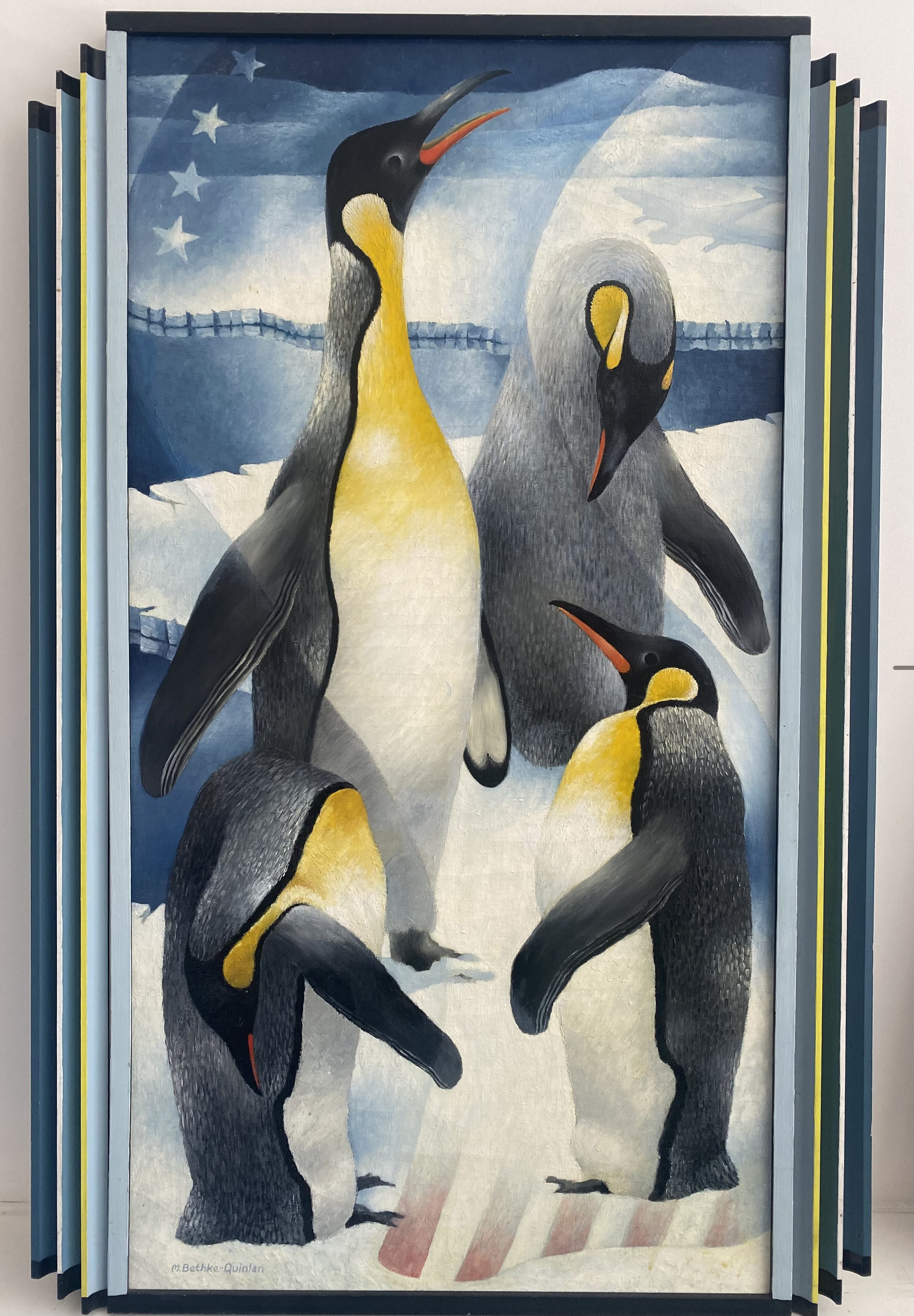
Floyd Bennett was Admiral Richard Byrd’s pilot when they flew over the North Pole.
He was to have been the pilot for the South Pole flight, but he died shortly before the expedition was to leave. Admiral Byrd took a stone from the grave of Bennett in Arlington Cemetery and wrapped it in an American flag which he dropped as he flew over the South Pole.
Hasbrough Heights, NJ, was once the home of Floyd Bennett. Bernt Balchen, the pilot who replaced Bennett, also came from the same town.
The shadow of the plane and the American flag are linked with the King Penguins as they are one of the first signs that indicate arrival in the Antarctic area.